
Trademark Registration
Trademark registration is the legal process of securing federal protection for your brand name, logo, slogan, or other distinctive identifiers. For businesses building long-term value, federal registration is not simply a formality — it is a foundational step in protecting brand equity, enforcing rights, and establishing nationwide priority.
Whether you are launching a new venture or strengthening an established brand, understanding how trademark registration works is essential. This guide explains what trademark registration is, what can be registered, how the process unfolds before the United States Patent and Trademark Office (USPTO), and why professional guidance can make a significant difference.

What Is Trademark Registration?
Trademark registration is the formal process of applying for and obtaining federal protection for a trademark through the United States Patent and Trademark Office (USPTO). A trademark identifies and distinguishes the source of goods or services. When properly registered, it grants the owner powerful legal rights throughout the United States.
Federal Trademark Registration
Federal registration provides nationwide legal recognition of your ownership rights in connection with the goods or services listed in your application. Once approved, your trademark is entered into the federal register and becomes publicly searchable.
This registration offers legal presumptions that are not available under common law, including:
- Presumption of ownership
- Presumption of validity
- Presumption of exclusive right to use the mark nationwide in connection with the listed goods/services
These presumptions significantly strengthen your ability to enforce your brand against infringers.
The USPTO Process
The USPTO reviews trademark applications to ensure they meet statutory requirements. The agency examines whether the mark:
- Is distinctive
- Is not confusingly similar to existing registrations
- Properly identifies goods or services.
- Includes acceptable specimens (proof of use, if required)
If the application meets legal standards and no opposition is filed, the mark proceeds to registration.
Common Law vs. Registered Trademark Rights
In the United States, trademark rights are created through use in commerce — not registration alone. This means a business can develop legally enforceable rights in a name, logo, or slogan simply by using it to identify goods or services. These are known as common law trademark rights.
However, common law protection is limited in scope and strength.
Common law rights generally extend only to the geographic areas where the mark is actually used and where the business has established market recognition. If two businesses in different states independently adopt the same or similar mark without knowledge of one another, each may develop rights in their respective territories. This can create complex disputes if one later expands into the other’s market.
In addition, common law rights:
- Do not automatically appear in federal trademark databases.
- Do not provide nationwide priority.
- Require the owner to prove validity, ownership, and scope of rights in any dispute.
- Offer limited deterrent effect against third parties adopting similar marks.
Because common law rights depend heavily on proof of actual use and reputation, enforcement can be more burdensome and uncertain.
Federal registration, by contrast, provides broader and more predictable protection.
When a mark is federally registered with the United States Patent and Trademark Office (USPTO), the owner gains substantial legal advantages, including:
- Nationwide constructive notice of ownership – Others are legally presumed to know about the registered mark, even if they claim they were unaware of it.
- Nationwide priority dating back to the application filing date – This can be critical when expanding into new markets.
- Access to federal courts – Registered owners may bring infringement actions under federal trademark law.
- Stronger enforcement tools – Registration enhances available remedies, including potential recovery of damages, profits, and attorneys’ fees in certain cases.
- Greater deterrence against infringement – Public registration and the ability to use the ® symbol often discourage competitors from adopting confusingly similar marks.
Federal registration also simplifies disputes by creating legal presumptions of validity and ownership. Instead of proving the existence and scope of rights from the ground up, the registered owner begins with recognized statutory advantages.
For businesses operating online, expanding across state lines, licensing their brand, attracting investors, or planning long-term growth, federal registration is often essential. In an interconnected marketplace, geographic boundaries are less meaningful than they once were. Without nationwide protection, a growing business may encounter preventable conflicts that disrupt expansion or dilute brand value.
While common law rights provide a starting point, federal registration transforms a brand from a locally protected asset into a nationally recognized legal right.
What Can Be Registered as a Trademark?
Trademarks extend beyond business names. Many different brand elements may qualify for federal protection if they function as source identifiers.
Names
Business names, product names, and brand names are among the most commonly registered trademarks. Distinctive and unique names are generally stronger and easier to protect than descriptive or generic terms.
Logos
Logos, stylized text, and design marks can be registered independently or in combination with wording. Visual branding elements often play a critical role in consumer recognition.
Slogans
Catchphrases and taglines may be registrable if they identify the source of goods or services and are not merely descriptive or informational.
Product Packaging
Distinctive packaging that identifies the source of a product may qualify for trademark protection. This includes unique visual presentations that consumers associate with a specific brand.
Service Marks
Service marks function similarly to trademarks but identify services rather than physical goods. The legal framework governing service marks is the same as for trademarks.
Trade Dress
Trade dress refers to the overall look and feel of a product or its packaging — including design, shape, color combinations, and presentation. To qualify, trade dress must be distinctive and non-functional.
Determining whether a particular element qualifies for registration often requires legal analysis, particularly when distinctiveness is not immediately clear.
The Trademark Registration Process
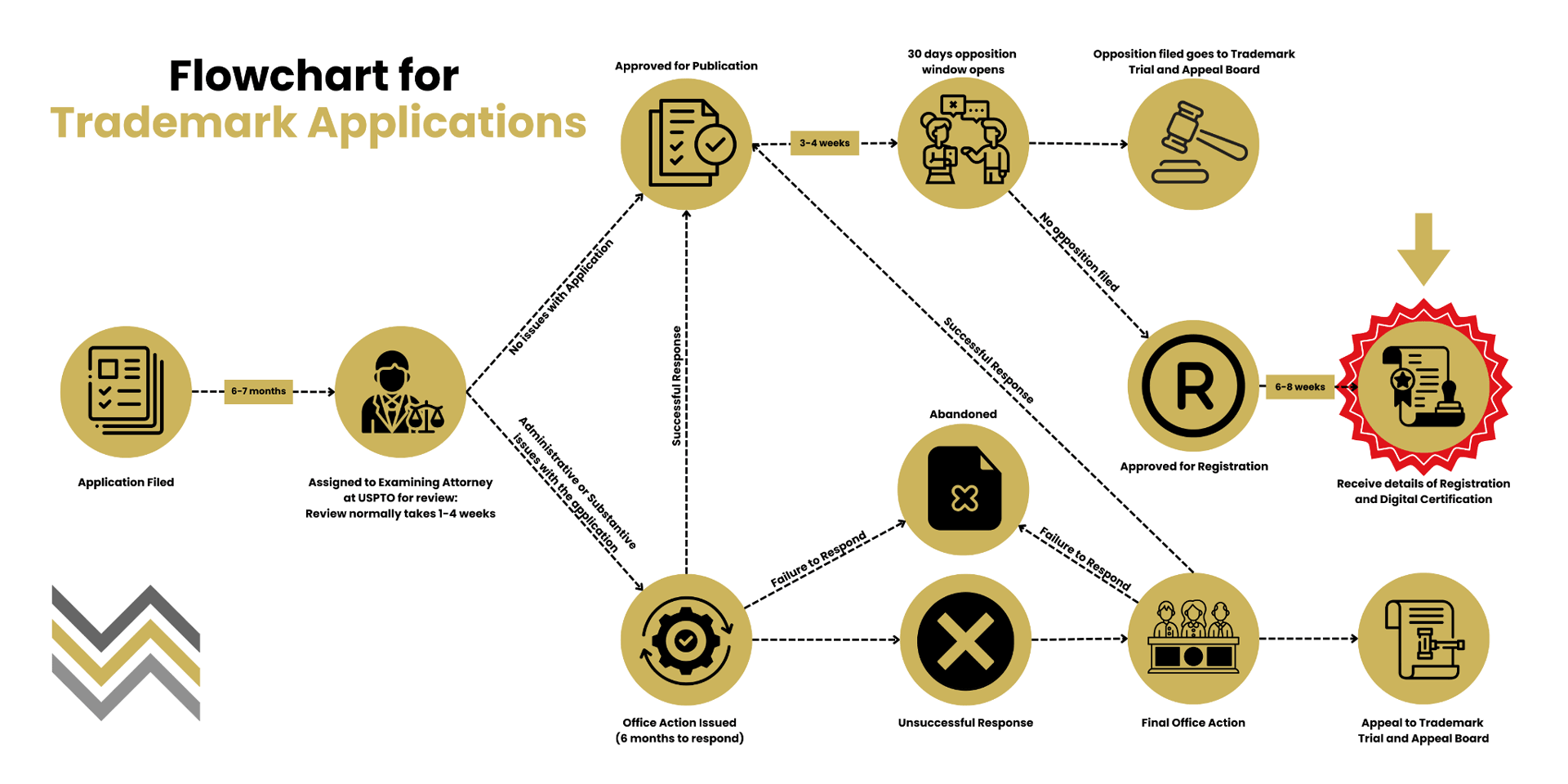
Federal trademark registration follows a structured process. While each application is unique, most proceed through the following stages:
1. Clearance Search
Before filing, a comprehensive trademark clearance search is critical. This step involves reviewing:
- Federal trademark registrations and pending applications
- State trademark databases
- Common law uses
- Business names and domain names
The purpose is to identify potential conflicts that could lead to refusal based on the likelihood of confusion. Skipping this step increases the risk of rejection and future disputes.
2. Filing the Application
The application must include:
- The mark (word, design, or combination)
- The goods or services associated with the mark
- The filing basis (use in commerce or intent to use)
- Specimens of use, if applicable
Proper identification of goods and services is particularly important. Overly broad or improperly classified descriptions often lead to delays or refusals.
3. USPTO Examination
After filing, a USPTO examining attorney reviews the application. This review typically occurs several months after submission.
The examiner assesses whether the mark complies with federal trademark law and determines whether any grounds for refusal exist.
4. Office Actions
If issues are identified, the USPTO issues an Office Action outlining objections or refusals. Applicants are given a limited period to respond.
Responses must address each legal issue raised. Inadequate responses can result in abandonment of the application.
5. Publication for Opposition
If the examining attorney approves the application, it is published in the Official Gazette. During this period, third parties may oppose registration if they believe the mark would harm their rights.
If no opposition is filed, the application proceeds forward.
6. Registration
For marks already in use, registration is issued following the opposition period. For intent-to-use applications, a Notice of Allowance is issued, and proof of use must be submitted before registration is granted.
Maintaining a registration requires ongoing compliance, including renewal filings and proof of continued use.
Common Challenges in Trademark Applications
Trademark applications are frequently delayed or refused due to legal or procedural issues. Understanding common challenges highlights the importance of careful preparation.
Likelihood of Confusion Refusals
One of the most common grounds for refusal occurs when the USPTO determines that a mark is confusingly similar to an existing registration. The analysis considers factors such as:
- Similarity in appearance, sound, or meaning
- Relatedness of goods or services
- Channels of trade
Even marks that are not identical may be refused if consumers could mistakenly believe the goods or services come from the same source.
Descriptiveness Refusals
Marks that merely describe a characteristic, quality, or function of the goods or services may be refused. Descriptive terms generally cannot be registered without proof of acquired distinctiveness.
Choosing inherently distinctive marks significantly reduces this risk.
Specimen Issues
Applications based on use in commerce must include acceptable specimens. Common issues include:
- Improper formatting
- Inadequate proof of use
- Use is inconsistent with the listed goods/services.
Specimen refusals require precise corrective responses.
Office Action Responses
Responding to an Office Action requires legal argument, evidence, and sometimes amendments to the application. Strategic responses can often overcome refusals, but poorly drafted responses may lead to final rejection.
Benefits of Federal Trademark Registration
Federal trademark registration provides meaningful legal advantages that extend beyond common law protection.
Nationwide Priority
Registration establishes constructive nationwide priority as of the application filing date, even if the mark is not yet used in every state.
Presumption of Ownership and Validity
A registered trademark carries legal presumptions that simplify enforcement and strengthen litigation positions.
Enhanced Enforcement Rights
Registration allows trademark owners to:
- File infringement actions in federal court
- Seek statutory remedies
- Rely on public record notice to deter infringers.
Use of the ® Symbol
Only federally registered trademarks may use the ® symbol. This designation signals legal protection and often deters unauthorized use.
Customs Enforcement
Registered trademarks may be recorded with U.S. Customs and Border Protection to help prevent the importation of counterfeit goods.
These benefits collectively strengthen brand protection strategies and support long-term brand development.
How a Trademark Attorney Assists With Registration
Although individuals may file trademark applications independently, professional guidance reduces risk and improves outcomes.
Conducting Clearance Searches
Attorneys perform detailed searches and analyze potential conflicts. A legal assessment goes beyond database results and evaluates risk under established trademark principles.
Preparing Applications Accurately
Drafting precise goods and services descriptions, selecting appropriate filing bases, and ensuring compliance with USPTO requirements help avoid preventable refusals.
Responding to USPTO Office Actions
Legal arguments addressing likelihood of confusion, descriptiveness, and procedural objections require knowledge of trademark law and prior USPTO decisions. Thoughtful responses can often overcome objections that would otherwise result in refusal.
Avoiding Costly Rejections
Early strategic decisions — including mark selection and filing strategy — can prevent disputes, delays, and unnecessary expenses.
Trademark registration is not merely administrative; it is a legal process that directly impacts enforceability and brand value. Proper guidance helps ensure that protection is meaningful, durable, and aligned with long-term business objectives.
For a broader overview of our intellectual property services, you may explore our trademark practice areas.
FAQs about Trademark Registration
Trademarks are an essential part of any business, big or small. They help protect your brand and distinguish your products or services from those of your competitors. Here, we answer some common questions, from what trademarks are and why they’re important, to how register and maintain them. So, whether you’re a startup or an established business, read to learn more about trademarks and how they can benefit your brand.